Losing a pet is every owner’s worst fear, and microchipping offers permanent identification that can reunite you with your companion even years after they’ve gone missing. Unlike collars and tags that can fall off or become unreadable, a microchip provides a reliable way to prove ownership and ensure your pet can find their way back home.
At Your Family Veterinarian, we believe that every pet deserves the security of proper identification. Our husband-and-wife veterinarian team, Dr. Morales and Dr. Fernandez, makes microchipping a quick, safe procedure that gives Miami pet owners lasting peace of mind. We treat every patient as we would our own pets, combining advanced technology with the compassionate, fear-free approach that keeps animals calm during their visit for any treatment.
What Is Pet Microchipping?
A microchip is a tiny electronic device, about the size of a grain of rice, that contains a unique identification number. The veterinarian implants this chip beneath your pet’s skin, typically between the shoulder blades. The procedure takes just seconds and requires no anesthesia or surgery.
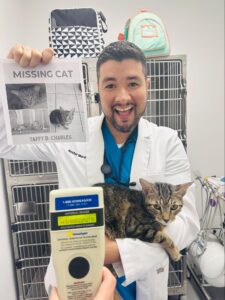
When a lost pet arrives at a shelter or veterinary clinic, staff members use a special scanner to detect the microchip. This scanner reads the identification number, which connects to a registry database containing your contact information. The shelter can then reach out to reunite you with your pet. The entire system works because the chip remains readable for your pet’s entire lifetime without requiring batteries or maintenance.
How Microchipping Differs from Other Identification
Collars and ID tags serve an important purpose, but they have limitations. Tags can fade, break, or slip off during your pet’s adventures. Microchips stay in place permanently and cannot be removed or altered by anyone who might find your pet. This makes them especially valuable for outdoor cats, dogs who slip out of collars, or any pet who might be stolen.
Feature
🐾 Microchip
Collar & ID Tag
Permanent?
✔ Yes — lasts a lifetime
✘ Can fall off or break
Can be removed?
✔ No — subcutaneous
✘ Yes — by anyone
Proves ownership?
✔ Yes — via registry
✘ No legal proof
Requires maintenance?
✔ Registry update only
✘ Tags fade, replace often
GPS tracking?
ID number only (no GPS)
Contact info visible if readable
The microchip itself contains no GPS tracking capability. It simply stores an identification number that links to your contact details in a database. You’ll need to register the chip after implantation and update your information whenever you move or change phone numbers.
The Microchipping Procedure
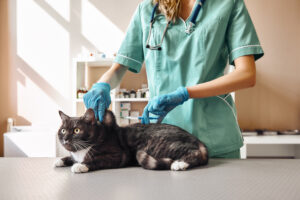
Our team understands that any medical procedure can feel worrisome for pet parents. The microchipping process is straightforward and causes minimal discomfort. The veterinarian uses a sterile needle to inject the chip under the skin, similar to giving a standard vaccination. Most pets react to microchipping the same way they respond to their regular shots, with just a brief moment of pressure.
You can schedule microchipping during a regular wellness visit or as a standalone appointment. There’s no recovery period needed, so your pet can return to normal activities immediately. We scan the chip right after placement to verify it’s working correctly and shows up on our equipment.
Step 1
Quick Injection
A sterile needle places a rice-sized chip beneath your pet’s skin — between the shoulder blades — in a matter of seconds. No anesthesia required.
Step 2
Instant Verification
Our veterinarian scans the chip immediately after placement to confirm it’s active, readable, and correctly registered in our clinic system.
Step 3
Registry Enrollment
You receive the chip number and registry instructions. Complete your enrollment online and keep the paperwork — this is what reunites you with your pet if they’re ever lost.
Best Age for Microchipping
Puppies and kittens can receive microchips as young as eight weeks old, though many veterinarians prefer waiting until they’re slightly older and receiving their first vaccinations. Adult pets benefit from microchipping at any age. If you’ve recently adopted an older pet, having them scanned for an existing chip should be one of your first steps. Many rescues and shelters already microchip animals before adoption, but verifying the chip is registered to your current information remains essential.
Benefits of Microchipping Your Pet in Miami
50%+
More dogs returned to owners when microchipped
20×
More likely microchipped cats are reunited with families
1×
One-time procedure — lasts your pet’s entire lifetime
0
Batteries, maintenance, or ongoing fees required
Microchipping dramatically increases the chances of reuniting with a lost pet. Studies show that dogs with microchips are returned to their owners over 50% more often than dogs without them, while microchipped cats return home more than 20 times as often as non-microchipped cats. These numbers reflect the reality that collars come off, but microchips stay put.
Beyond recovery assistance, microchips provide proof of ownership in disputes. If someone claims your pet belongs to them or if your animal ends up in a shelter after being picked up as a stray, the microchip registry shows who the rightful owner is. This documentation becomes especially important in areas affected by natural disasters, where pets may become separated from families during evacuations.
The one-time cost of microchipping is minimal compared to the value of your pet’s safety. Once placed, the chip lasts your pet’s entire life without additional fees, though maintaining current information in the registry database is your responsibility as the owner.
Maintaining Your Pet's Microchip Registration
Getting your pet microchipped is only the first step. The system works because your contact information stays current in the microchip registry. When you first have your pet chipped, you’ll receive paperwork with the chip number and instructions for registering with the database company. Complete this registration as soon as possible and keep the paperwork in a safe place.
Update your information whenever you move, change phone numbers, or transfer ownership of your pet. Most registry companies allow you to log in online and make changes to your account at no charge. If you adopt a pet that’s already microchipped, contact the registry company listed in the adoption paperwork to transfer the chip to your name.
Some pet owners register with multiple databases to increase the chances of their pet being found, since different shelters and clinics may use different scanning systems or check different registries first. Universal pet microchip lookup tools now exist that search multiple databases simultaneously, but maintaining accurate information in your primary registry remains the most important action you can take.
Frequently Asked Questions About Pet Microchipping
The microchipping procedure is quick and causes minimal discomfort. The chip is implanted using a sterile needle — similar to a standard vaccination — and takes only a few seconds. No anesthesia is required, and most pets react no more than they would to a routine injection. Our team uses fear-free handling techniques throughout the process to keep your pet calm and comfortable. After placement, the area may be slightly tender for a short time, but pets typically return to normal activities immediately.
When a lost pet is brought to a shelter, veterinary clinic, or animal control facility, staff scan the animal with a universal reader. The scanner detects the chip and displays a unique ID number. That number is then looked up in a microchip registry database, which pulls up your contact information. The shelter or clinic reaches out to you directly. The system only works if your registration is current — the chip itself is permanent, but your contact details in the registry need to stay up to date whenever you move or change phone numbers.
No — a microchip is a passive RFID device, not a GPS tracker. It does not emit a signal on its own and cannot tell you where your pet is in real time. It only becomes active when a scanner passes over it, at which point it transmits a unique ID number. If you want real-time location tracking, a GPS collar attachment can serve that purpose alongside the microchip. We recommend both: the microchip as permanent, tamper-proof identification, and a GPS device for active tracking if your pet is prone to wandering.
Puppies and kittens can be microchipped as young as eight weeks old, and we often perform the procedure during an early wellness or vaccination visit to minimize the number of separate appointments needed. Adult and senior pets can be microchipped at any age — it is never too late. If you've adopted an older pet and aren't sure whether they already have a chip, we can scan for one during any visit at no charge. We confirm chip placement and readability immediately after every procedure.
After the chip is placed, you'll receive the chip's ID number along with instructions for completing your registry enrollment online. Registering is essential — the chip is only useful if your contact information is linked to that number in a searchable database. Keep your registration current whenever you move, change phone numbers, or transfer ownership of your pet. Some pet owners also register with multiple databases to increase the chances of a successful lookup, since different shelters may reference different registries. We're happy to walk you through the process at your appointment.
Yes — microchipping can be added to any wellness visit or vaccination appointment at Your Family Veterinarian. There's no need to schedule a separate trip. The procedure takes only a few seconds and requires no recovery time, so it fits easily alongside your pet's other care. If you'd prefer a standalone appointment dedicated to microchipping, we accommodate that as well. Either way, our team ensures the chip is properly placed, immediately scanned to confirm it reads correctly, and linked to our clinic records before you leave.
Schedule Your Pet’s Microchipping Appointment at Your Family Veterinarian
Your pet’s safety matters to us as much as it matters to you. As a family-owned practice in Miami, we take the time to answer your questions and ensure you feel comfortable with every aspect of your pet’s care. Our use of fear-free handling techniques and our calm environment helps pets stay relaxed during quick procedures like microchipping.
We utilize advanced technology throughout our clinic to provide the highest-quality medical care, and our commitment to treating every patient as part of our own family sets us apart. Contact Your Family Veterinarian today to schedule your pet’s microchipping appointment and give yourself the peace of mind that comes with permanent identification.
A clean and disease-free mouth is imperative for the health and longevity of your pet. Let our veterinarians protect and care for your pet’s teeth. Give us a call at (786) 885-1590 to schedule an appointment for your furry friend today.
“Dr. Morales is an amazing veterinarian. He has been treating my dog Marino since he was three weeks old and who is now three years old. He cares for Marino as if its his own pet. As a pet owner, I have always felt secure and confident with Dr. Morales’ care treatment my for Marino. I can’t wait for you and your wife to open your new pet clinic. Congratulations Dr. Morales and Dr. Fernandez on your business and new bundle of joy!”
—Yamaris
“My dog, a 100+ pound ball of nerves, makes it almost impossible for vets to treat him. However, Dr. Morales has such a way with animals that he’s the only one who makes him feel comfortable (they even take selfies together). I cannot say enough great things about him and the service he provides to all fur babies. Hachi can’t wait to visit soon!!!”